2. what are some elements of the rainbow serpent that may match to existing snakes today?

Australian Aboriginal rock painting of the "Rainbow Snake".
The Rainbow Serpent or Rainbow Ophidian is a common deity ofttimes seen as a creator god,[ane] known past numerous names in unlike Australian Aboriginal languages by the many different Aboriginal peoples. It is a common motif in the art and religion of many Aboriginal Australian peoples.[2]
There are many names and stories associated with the snake, all of which communicate the significance and ability of this being within Aboriginal mythology, which includes the worldview commonly referred to equally The Dreaming. The snake is viewed equally a giver of life through its association with water, only tin be a destructive force if angry. The Rainbow Snake is one of the most common and well-known Aboriginal stories and is of great importance to Aboriginal society.[iii] [4]
Not all of the myths of the ancestral being link a rainbow with the snake and not all describe the being every bit a ophidian, but there is unremarkably a link with water or rain.[v] When the rainbow is seen in the sky, it is said to be the Rainbow Ophidian moving from ane waterhole to another and the divine concept explained why some waterholes never dried upward when drought struck.[v]
The Rainbow Serpent Festival is an annual festival of music, arts and civilization in Victoria.[vi]
Names in different cultures [edit]
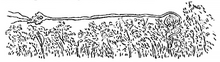
The Rainbow Serpent is known by different names by the many different Aboriginal cultures.
Yurlunggur is the name of the "rainbow serpent" co-ordinate to the Murngin (Yolngu) in n-eastern Arnhemland,[seven] also styled Yurlungur,[8] [2] Yulunggur,[ix] [10] Jurlungur,[11] Julunggur[12] or Julunggul.[thirteen] [fourteen] The Yurlunggur was considered "the keen father".[viii]
The serpent is called Witij/Wititj by the Galpu clan of the Dhangu people, ane of Yolngu peoples.[i] [15]
Kanmare is the proper name of the great water serpent in Queensland[a] among the Pitapita people of the Boulia District; it is apparently a giant carpet serpent, and recorded under the name Cunmurra further s.[b] [17] [20] The aforementioned snake is chosen Tulloun amongst the Mitakoodi (Maithakari).[21] 2 mythical Kooremah of the Mycoolon (Maikulan) tribe of Queensland, are cosmic rug snakes 40 miles long, residing in watery realm of the expressionless, or on the pathway leading to information technology;[22]this is probably equivalent to the rainbow ophidian also.[23]
Other names include:
- Bolung in the Northern Territory, by the Dangbon/Dalabon/Buan and Rembarrnga[24] [25]
- muitj (var. Moitt, Muit ) in Cardinal Arnhemland [26] by the Rembarrnga,[27] etc.
- Ngalyod [c] by the Kunwinjku[two] [28]
- Yingarna, the original (female) Rainbow Serpent, whose son is Ngalyod, though these names may be used interchangeably[29] [30]
- Dhakkan (or Takkan) by the Gubbi Gubbi (Kabi)[5]
- Andrénjinyi by the natives of Pennefather River, North Queensland[31]
- Kajura by the Ingarda[5]
- Goorialla by the Lardil people[32]
- Wanampi by the Aṉangu[33]
- Kunmanggur by the Murinbata[2]
- Numereji by the Kakadu (Gaagudju)[34]
- Taipan by the Wikmunkan[2]
- Wagyl by the Noongar[35]
- Wanamangura past the Thalanyji (Talainji)[five]
- Galeru [2]
- Langal [ii]
- Myndie [36]
- Ungur [2]
- Wollunqua past the Warumungu[2]
- Wonambi [2]
- Wonungar [2]
- Worombi [2]
- Yero [two]
Development of concept [edit]
Though the concept of the Rainbow Serpent has existed for a very long fourth dimension in Ancient Australian cultures, it was introduced to the wider world through the work of anthropologists.[37] In fact, the name Rainbow Serpent or Rainbow Snake appears to have been coined in English by Alfred Radcliffe-Brown, an anthropologist who noticed the same concept going nether unlike names amongst various Ancient Australian cultures, and called it "the rainbow-snake myth of Australia."[5] It has been suggested that this name implies that at that place is simply one Rainbow Serpent, when the concept actually varies quite a bit from one Aboriginal culture to some other, and should be properly called the Rainbow Serpent myths of Australia.[38]
Information technology has besides been suggested that the Serpent's position every bit the most prominent creator god in the Australian tradition has largely been the cosmos of not-Aboriginal anthropologists.[37] Another mistake of the same kind is the style in which Western-educated people, with a cultural stereotype of Greco-Roman or Norse myths, tell the Aboriginal stories in the by tense. For the indigenous people of Australia, the stories are everywhen – past, present and future.[39]
Characteristics [edit]
The rainbow serpent is in the beginning case, is the rainbow itself.[40] [d] It is said to inhabit detail waterholes, springs etc., owing to the fact that such bodies of water tin showroom spectral colors by diffracting lite, according to i caption.[40] Likewise, the rainbow quartz crystal and certain seashells are besides associated with the Rainbow Serpent, and are used in rituals involving the rainbow serpent.[2] [e] The underlying reasons are likewise explainable, since quartz acts every bit a prism to diffract light into different colours, while the mother of pearl exhibits an iridescence of colours.[42] [f]
The Dreaming[3] (or Dreamtime or Tjukurrpa or Jukurrpa[ane]) stories tell of the great spirits and totems during creation, in fauna and human form that moulded the arid and featureless earth. The Rainbow Snake came from beneath the basis and created huge ridges, mountains, and gorges every bit it pushed up. The Rainbow Serpent is understood to be of immense proportions and inhabits deep permanent waterholes[44] and is in control of life's most precious resource, water. In some cultures, the Rainbow Serpent is considered to be the ultimate creator of everything in the universe.[14]
In some cultures, the Rainbow Ophidian is male; in others, female; in even so others, the gender is ambiguous or the Rainbow Serpent is hermaphroditic[2] or bisexual, thus an androgynous entity. Some commentators have suggested that the Rainbow Ophidian is a phallic symbol,[45] which fits its connectedness with fertility myths and rituals. When the Serpent is characterized as female or bisexual, information technology is sometimes depicted with breasts, equally in the case of the Kunmanggur ophidian.[46] [47] Other times, the Serpent has no particular gender.[48]
The serpent is sometimes ascribed with a having crest or a mane or on its head, or being disguised besides.[12]
while it is single-headed, the Yurlunggur of Arnhem land may possess a double-body.[12]
In some stories, the Serpent is associated with a bat, sometimes chosen a "flying fox" in Australian English, engaged in a rivalry over a woman.[48] Some scholars have identified other creatures, such as a bird, crocodile, dingo,[38] or lizard, every bit taking the role of the Serpent in stories. In all cases, these animals are also associated with water.[25] The Rainbow Serpent has also been identified with, or considered to be related to, the bunyip, a fearful, water-hole dwelling creature in Australian mythology.[49] [38] [50]
The sometimes unpredictable Rainbow Serpent (in dissimilarity to the unyielding sunday) replenishes the stores of water, forming gullies and deep channels as the Rainbow Serpent slithers beyond the landscape.[51] In this conventionalities system, without the Serpent, no rain would fall and the Earth would dry out upward.[iii] In other cultures, the serpent stops rainfall: the Numereji serpent'southward iwaiyu (its soul or shadow) cast upon the sky becomes the rainbow, and the serpent ascends to stop the rain,[34] the Andrénjinyi is said to halt the pelting caused by enemies.[31]
The Rainbow Snake is sometimes associated with human claret, particularly circulation and the menstrual cycle, and considered a healer.[ii] Thunder and lightning are said to stem from when the Rainbow Serpent is angry,[2] and the Snake can fifty-fifty crusade powerful rainstorms and cyclones.[3]
Serpent stories [edit]
Stories about the Rainbow Snake have been passed down from generation to generation.[35] The serpent story may vary notwithstanding, co-ordinate to environmental differences. Peoples of the monsoonal areas depict an epic interaction of the dominicus, Serpent, and wind in their Dreamtime stories, whereas those of the fundamental desert experience less desperate seasonal shifts and their stories reverberate this.[51] It is known both as a benevolent protector of its people (the groups from the state around) and as a malevolent punisher of law breakers. The Rainbow Serpent'south mythology is closely linked to land, h2o, life, social relationships, and fertility. The Rainbow Serpent oftentimes takes function in transitions from boyhood to adulthood for young men and swallows them to vomit them upwardly later.[2]
The most common motif in Rainbow Serpent stories is the Serpent every bit creator, with the Ophidian often bringing life to an empty space.[4]
One prominent Rainbow Serpent myth is the story of the Wawalag[xiv] or Wagilag sisters, from the Yolngu people of Arnhem Country.[ane] According to legend, the sisters are travelling together when the older sis gives birth, and her blood flows to a waterhole where the Rainbow Snake lives.[14] In another version of the tale, the sisters are travelling with their mother, Kunapipi, all of whom know ancient secrets, and the Serpent is merely angered past their presence in its surface area.[one] The Rainbow Serpent then traces the scent back to the sisters sleeping in their hut, a metaphor for the uterus. The Rainbow Serpent enters, a symbolic representation of a snake entering a hole, and eats them and their children. Nevertheless, the Rainbow Ophidian regurgitates them after being bitten by an emmet,[xiv] and this act creates Arnhem Land. Now, the Serpent speaks in their voices and teaches sacred rituals to the people living there.[one]
Wollunqua is the Warumungu people's version of the Rainbow Snake, telling of an enormous snake which emerged from a watering pigsty called Kadjinara in the Murchison Ranges, Northern Territory.[52]
Another story from the Northern Territory tells of how a corking female parent arrives from the sea, travelling across Australia and giving birth to the various Aboriginal peoples.[53] In some versions, the great mother is accompanied by the Rainbow Serpent (or Lightning Snake), who brings the wet flavour of rains and floods.[53]
From the Bang-up Sandy Desert surface area in the northern part of Western Australia comes a story that explains how the Wolfe Creek Crater, or Kandimalal, was created by a star falling from heaven, creating a crater in which a Rainbow Serpent took upwards residence, though in some versions it is the Serpent which falls from heaven and creates the crater. The story sometimes continues telling of how an old hunter chased a dingo into the crater and got lost in a tunnel created by the Serpent, never to exist establish again, with the dingo existence eaten and spat out by the Snake.[54]
The Noongar people of south-western Western Australia tell of how Rainbow Serpents, or Wagyls, smashed and pushed boulders around to form trails on Mount Matilda, along with creating waterways such as the Avon River.[35] Some Ancient peoples[ who? ] in the Kimberley region believe that it was the Rainbow Ophidian who deposited spirit-children throughout pools in which women become impregnated when they wade in the h2o. This process is sometimes referred to as "netting a fish".[14]
A more kid-friendly version of the Rainbow Ophidian myth tells of how a serpent rose through the World to the surface, where she summoned frogs, amused their bellies to release h2o to create pools and rivers, and is at present known every bit the mother of life.[30] Another tale is told in Dick Roughsey'southward children'due south book, which tells how the Rainbow Snake creates the landscape of Commonwealth of australia by thrashing near and, by tricking and swallowing ii boys, ends up creating the population of Australia past various animal, insect, and plant species.[32]
Iconography [edit]
The Serpent has been depicted in rock art in various forms, more often than not snake-like but it may have heads resembling marsupials (macropods) or flying foxes, fifty-fifty birds or humans.[55] Dissimilar an ordinary serpent in nature, it may also be depicted with additional appendages such as animal legs and feet, likewise manifests tails of various forms in rock art.[55]
Possible origins in nature [edit]
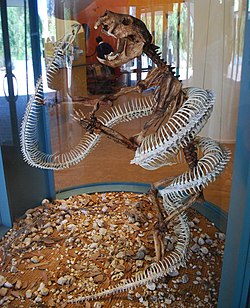
Wonambi naracoortensis and Thylacoleo
Various species/taxa of snakes in the natural world have been proposed as the model for the rainbow serpent. Areas where rainbow serpent myth seemingly overlaps with the habitat range of Boidae family snakes (boas) in general.[56]
One proposition is that it is modeled on the "rock python", regarding the rainbow serpent in the myth of the Wawilak sisters among the Yonglu people.[58] In some tellings of the sisters myth, the come across with the Yurlunggur ophidian occurs in its water-pigsty called the Mirrimina well, glossed as 'stone python's dorsum'.[8] Specifically, the banded rock python (aka Children'southward python; Liasis childreni <sc>syn.</sc> Antaresia childreni) has been identified with the Yurlunggur past 1 researcher.[59] This species is of chocolate-brown color[lx] (cf. Yurlunggur described equally "giant copper serpent"[8]) flecked with darker patches and having a ventral side that is opalescent white.[threescore]
Some other proposition is the Oenpelli rock python (aka Oenpelli python),[61] which is called nawaran in the native Kunwinjku language, according to whose lore grew into the Ngalyod serpent.[62] This snake is also brown with darker blotches[60] with iridescent scales.[61]
Some other candidate is the water python (Liasis fuscus), which is a particularly colourful serpent.[63] [64] [k]
The rug snake (Morelia spilota variegata) is considered a grade that the Rainbow Ophidian can have by the Walmadjari people in northern Western Australia.[51] The Kanmare or Kooremah of Queensland are also considered enormous rug snakes, as already mentioned.[65]
- Paleoherpetology
In Queensland, a fossil of a snake was plant, and they believe that information technology came from the prehistoric family unit of large snakes that may accept inspired the original Rainbow Snake.[37]
Wonambi is a genus that consisted of two species of very large snakes. These species were not pythons, similar Australia'southward other large constrictors of the genus Morelia, and are currently classified in the extinct family Madtsoiidae that became extinct elsewhere in the world 55 million years in the past.[ citation needed ]
Role in traditional culture [edit]
In addition to stories about the Rainbow Serpent existence passed down from generation to generation, the Rainbow Ophidian has been worshipped through rituals and has besides inspired cultural artefacts such equally artwork and songs, a tradition which continues today.[14]
There are many ancient rituals associated with the Rainbow Serpent that are nonetheless practised today.[xiv] The myth of the Wawalag sisters of Arnhem Land in the Northern Territory marks the importance of the female period process and led to the institution of the Kunapipi claret ritual of the goddess, in which the Indigenous Australians allegorically recreate the Rainbow Ophidian eating the Wawalag sisters through dance and pantomime, and can exist regarded as a fertility ritual.[14]
Female catamenia is sacred to many Ethnic Australian cultures because it distinguishes the time when a female person is capable of bringing life into the globe, putting a adult female on the same level of creative abilities as the Rainbow Ophidian. Information technology is for this reason that men will try to mimic this holy process by cutting their arms and/or penises and letting their claret run over their own bodies, each other's bodies, and even into a woman's uterus. Men will sometimes mix their claret with a women's menstrual claret, letting them flow together in a ceremonial unification of the sexes.[14]
The earliest known rock drawings of the Rainbow Serpent date dorsum to more than than 6,000 years ago.[fourteen] Because of its connections with fertility, the Rainbow Serpent is frequently illustrated as a vagina, and vice versa. Some stone art has been discovered in which the Rainbow Snake was drawn rima oris open and natural language out to represent the vaginal opening and streaming menstrual claret.[xiv]
The Rainbow Serpent is also identified every bit a healer and can pass on its properties equally a healer to humans through a ritual.[66]
Influence in mod civilisation [edit]
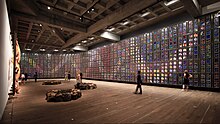
The Rainbow Snake, in addition to the continuation of traditional beliefs (which tin can be the subject of religious controversy), is often referenced in modern civilisation by providing inspiration for art, film, literature, music, religion, and social movements. For example, The Rainbow Snake Festival, an annual music festival in Australia,[67] and the Rainbow Snake Project, a series of films which document the filmmaker's journey to various sacred sites effectually the World,[68] are both inspired and named after the creature.
Many Ancient Australian artists continue to be inspired by the Rainbow Serpent and use information technology as a discipline in their art.[37]
The Rainbow Serpent has also appeared as a character in literature. The Lardil people's Dreaming story of the Rainbow Snake was retold in Dick Roughsey's accolade-winning Australian children'south book The Rainbow Ophidian;[32] the Rainbow Serpent has also appeared every bit a graphic symbol in comic books such as Hellblazer.[69] The Rainbow Serpent, nether the name Yurlungur, has featured equally a demon or persona[70] in several titles of the Megami Tensei series of Japanese office-playing games. The Rainbow Serpent has also appeared every bit an antagonistic character in the novel Optics of the Rainbow Serpent.[71]
The Rainbow Serpent tin still serve a religious role today, particularly for Ancient Australians, simply some Aboriginal Australians who are Christians turn down the belief and resent its identification with Aboriginal culture.[37] Some New Age religions and spirituality movements around the world accept now also adopted the Rainbow Ophidian as an icon.[37]
Similarly, the Rainbow Ophidian can inspire social movements.[66] Fine art historian Georges Petitjean has suggested that the identification of the Rainbow Ophidian with diverse genders and sexualities helps to explain why the rainbow flag has been adopted as the symbol of lesbian, gay, bisexual, and transgender communities.[66] Politically, for example, the Rainbow Serpent was adopted as the symbol of an anti-uranium mining entrada in Australia, using the notion that the mining would disturb the Serpent and cause it to seek revenge as a metaphor for environmental devastation.[66]
See besides [edit]
- Australian Aboriginal mythology § Rainbow Serpent
- Serpent (symbolism)
- Eingana
- Wirnpa
Notes [edit]
- ^ The starting time example in the 1926 rainbow serpent newspaper past Radcliffe-Brown.
- ^ Given as Cunmurra in Duncan-Kemp (1933), in here reminiscences at "Mooraberrie homestead, 138 miles (222 km) w of Windorah"; Mooraberrie Station beingness approximately 180 miles (290 km) south of Boulia.
- ^ Or Ngalmudj.[24]
- ^ Or at to the lowest degree in some instances, identified with the rainbow (or otherwise associated with the rainbow).[21]
- ^ Quartz crystal and "elongated pieces of pearl-beat out, pindjauandja" used by medicine men of Forrest River District, in rites involving the rainbow serpent.[41]
- ^ The Serpent is likewise identified with a prismatic halo effectually the moon that can be regarded as a sign of rain.[43]
- ^ Other suggestions from a televised source include the scrub or amethystine python, the taipan, and the file snake.[64]
References [edit]
- Citations
- ^ a b c d e f Bird, Stephanie Rose (2006). "Australian Aborigines". In William M. Clements (ed.). The Greenwood Encyclopedia of World Folklore and Folklife. Westport, CT: Greenwood Press. pp. 292–299.
- ^ a b c d e f g h i j k l thousand n o p q r Mercatante, Anthony S.; Dow, James R. (2009). "Rainbow Snake". Facts On File Encyclopedia Of World Mythology And Legend (Third ed.). New York: Facts On File. pp. 817–818.
- ^ a b c d "The First Australians". SBS. SBS. Retrieved 29 April 2013.
- ^ a b Big Black Domestic dog Communications (6 March 2008). "The Dreaming". Australian Government. Retrieved 3 May 2013.
- ^ a b c d eastward f Radcliffe-Brown (1926).
- ^ "Well-nigh". Rainbow Snake Festival . Retrieved 9 August 2021.
- ^ Warner (1937), pp. 254–257 et passim. (besides discussed in Róheim (1951), p. 185, repr. Róheim (2021), p. 143).
- ^ a b c d Cotterell, Arthur (2003). "Overview: Yurlungur". Dictionary of Globe Mythology. Oxford University Press. pp. 295–296. ISBN9780191726934 . Retrieved 21 January 2020. also via Oxford Reference site
- ^ Berndt, Catherine H. (31 December 1970), "Monsoon and Love Current of air", Échanges et communications, De Gruyter, pp. 1306–1326, doi:x.1515/9783111698281-034, ISBN978-3-eleven-169828-one
- ^ Hargrave, Susanne (1983). "Two Sis Myths: A Structural Analysis". Oceania. 53 (4): 347–357. doi:10.1002/j.1834-4461.1983.tb01998.10. ISSN 0029-8077 – via JSTOR.
- ^ Mountford (1978), pp. 79–78.
- ^ a b c Brandenstein (1982), p. 64.
- ^ Elkin, Berndt & Berndt (1950), p. 32–33, 38–39, 41 (also discussed in Róheim (1951), p. 182, repr. Róheim (2021), p. 141).
- ^ a b c d east f g h i j k l Grove, Peggy (Winter 1999). "Myths, Glyphs, and Rituals of a Living Goddess Tradition". ReVision. 21 (3): vi–14.
- ^ "Djalu' Gurruwiwi" (PDF). Buku-Larrnggay Mulka Centre. 2015. Archived from the original (PDF) on 19 January 2020. Retrieved 19 January 2020 – via Hollow Logs Didgeridoos.
- ^ a b Roth, Walter Edmund (1897). Ethnological Studies Among the North-west-central Queensland Aborigines. Brisbane: Edmund Gregory. p. 153.
- ^ Roth (1897)[16] cited in Radcliffe-Brown (1926), p. 19
- ^ Johnston, T. Harvey (1943). "Aboriginal Names and Utilization of the beast in the Eyrean Region". Transactions of the Royal Society of South Australia. 67 (pt 2): 289.
- ^ Duncan-Kemp, Alice Monkton (1933). Our Sandhill Country. Angus & Robertson.
- ^ Johnston (1943), p. 289[18] citing Roth (1897)[16] and Duncan-Kemp (1933).[19]
- ^ a b Radcliffe-Brown (1926), p. 19.
- ^ a b McElroy, Westward. A. (1884). "Notes on Some Australian Tribes". The Journal of the Anthropological Establish of Cracking United kingdom of great britain and northern ireland and Ireland. 13: 291.
- ^ Radcliffe-Brown (1926), p. 20, citing Palmer.[22]
- ^ a b c Taylor, Luke (1996). "Appendix: Glossary of Kunwinkju Words". Seeing the Inside: Bawl Painting in Western Arnhem State. Clarendon Press. p. 261. ISBN9780198233541.
- ^ a b Maddock, Kenneth (1978b). "Metaphysics in a Mythical View of the World". In Buchler, Ira R.; Maddock, Kenneth (eds.). The Rainbow Serpent: A Chromatic Piece. Chicago: Mouton/Aldine. pp. 99–118. ISBN9783110807165.
- ^ Elkin (1961), p. four.
- ^ Maddock (1978b), p. 105.
- ^ Garde, Murray. "ngalyod". Bininj Kunwok online dictionary. Bininj Kunwok Regional Language Centre. Retrieved 16 June 2019.
- ^ Taylor (1990), p. 330 and 1996.[24]
- ^ a b Carroll, Colleen (1 September 2012). "Mythology in Art". Arts & Activities. 152 (1): 22–26.
- ^ a b Roth (1903), Bulletin 5, p. 10, cited in Radcliffe-Brownish (1926), p. 19
- ^ a b c Roughsey, Dick (1975). The Rainbow Snake. Sydney: Collins.
- ^ Young, Diana (2006). "Water as Land on the Pitjantjatjara Yankunytjatjara Lands South Australia". Worldviews: Surroundings, Culture, Religion. Brill Netherlands. 10 (2): 239–258. doi:10.1163/156853506777965839.
- ^ a b Radcliffe-Brownish (1926), p. 24.
- ^ a b c Kickett, Everett (1994). "The Trails of the Rainbow Serpents". Daniel Habedank. Retrieved 3 May 2013.
- ^ Mountford (1978), pp. 31–32.
- ^ a b c d east f Anderson, Sallie (December 2001). "Rejecting the Rainbow Ophidian: An Aboriginal Artist's Choice of the Christian God as Creator". Australian Journal of Anthropology. 12 (3): 291–301. doi:10.1111/j.1835-9310.2001.tb00078.ten.
- ^ a b c Mountford (1978).
- ^ Stanner, West. (1968), "After the Dreaming" (ABC Boyer Lecture Serial)
- ^ a b McElroy, W. A. (Dec 1955). "PSI Testing in Arnhem Country". Oceania. 26 (2): 118–126. doi:ten.1002/j.1834-4461.1955.tb00668.10. JSTOR 40329684.
- ^ Elkin (1930), p. 350 and Elkin (1977) p/. 129
- ^ Radcliffe-Brown (1926), pp. 19, 25.
- ^ Radcliffe-Brown (1926), p. 25.
- ^ Isaacs, Jennifer (1979). Australian Dreaming: 40,000 Years of Ancient History. Sydney: Lansdowne Press. ISBN978-0-7018-1330-7. OCLC 7274630. [ page needed ]
- ^ Berndt, Ronald (1951), Kunapipi: a study of an Australian aboriginal religious cult pp. 12–13, 31, cited in Maddock (1978a), p. two
- ^ Maddock (1978a), p. 6.
- ^ Brandenstein (1982), p. 62.
- ^ a b Maddock, Kenneth (1978a). "Introduction". In Buchler, Ira R.; Maddock, Kenneth (eds.). The Rainbow Serpent: A Chromatic Piece. Chicago: Mouton/Aldine. pp. ane–21. ISBN9783110807165.
- ^ Radcliffe-Brownish (1926), p. 22.
- ^ Seal, Graham (1999). The Lingo: Listening to Australian English. UNSW Printing. pp. xv–16. ISBN9780868406800.
- ^ a b c http://world wide web.bom.gov.au/iwk/climate_culture/rainbow_serp.shtml
- ^ Baldwin Spencer, Walter (1904). Northern Tribes of Central Australia. London: Macmillan. pp. 226, 631, 756. doi:ten.1017/cbo9780511751202. hdl:2027/coo1.ark:/13960/t6737bs6n. ISBN9780511751202.
{{cite volume}}: CS1 maint: engagement and yr (link) This article incorporates text from this source, which is in the public domain .
 - ^ a b "Australia". Encyclopedia of World Mythology. Galahad Books. 1975. pp. 54–56. ISBN978-0706403978.
- ^ Sanday, Peggy Reeves (2007). Aboriginal Paintings of the Wolfe Creek Crater: Track of the Rainbow Serpent. Philadelphia: Academy of Pennsylvania Museum of Archaeology and Anthropology.
- ^ a b Taçon, Wilson & Chippindale (1996), pp. 105, 123.
- ^ Lowenstein (1961), pp. 37, 38, cited in Taçon, Wilson & Chippindale (1996), pp. 103–104
- ^ Dooley, Deborah Anne (1995). Plain and Ordinary Things: Reading Women in the Writing Classroom. SUNY Printing. pp. 67–68. ISBN9780791423196.
- ^ Knight, Chris (1983). Levi-Strauss and the Dragon: Mythologiques Reconsidered in the Light of an Australian Aboriginal Myth, p. 22. Quoted in Dooley (1995), pp. 67–68.[57]
- ^ Brandenstein (1982), p. 116.
- ^ a b c Cogger, Harold (2014). Reptiles and Amphibians of Commonwealth of australia. Csiro Publishing. ISBN9780643109773. . Children's python or banded stone python p. 823, Oenpelli python, p. 828
- ^ a b Michael, Damian; Lindenmayer, David (2018). Rocky Outcrops in Australia: Environmental, Conservation and Management. Csiro Publishing. p. 64. ISBN9781486307920.
- ^ Evans, Nicholas (2003). Bininj Gun-wok: A Pan-dialectal Grammar of Mayali, Kunwinjku and Kune. Vol. 2. Research School of Pacific and Asian Studies, Australian National University. p. 586. ISBN9780858835306.
- ^ Taçon, Wilson & Chippindale (1996), p. 116 apud Lowenstein (1961) et Worrel (1966), Reptiles of Australia, p. 99 opp. 112
- ^ a b "Rainbow Serpent". National Geographic. Public Television'due south Wild Chronicles. Retrieved five April 2013.
- ^ Radcliffe-Dark-brown (1926), pp. 19, 20.
- ^ a b c d Petitjean, Georges (2012). Welling, Wouter (ed.). "'Casting Ahead Serpent-fashion': The Rainbow Serpent in Australia". Dangerous and Divine: The Secret of the Serpent: 172–181.
- ^ "Rainbow Snake Festival". Rainbow Snake Festival. Retrieved 11 April 2013.
- ^ Webster, Tor. "Rainbow Serpent Project". Retrieved 17 Apr 2013.
- ^ "Hellblazer" (89–90). New York: DC/Vertigo. May–June 1995.
- ^ "Persona v Yurlungur Stats Skills List". Samurai Gamers. 30 March 2020. Retrieved 11 July 2021.
{{cite spider web}}: CS1 maint: url-status (link) - ^ "Eyes of the Rainbow Snake". Amazon.com. 12 January 2022. Retrieved 12 January 2022.
{{cite web}}: CS1 maint: url-status (link)
See also the page for Aido Hwedo the Rainbow Snake deity of Africa.
- Bibliography
- Brandenstein, Carl Georg von (1982), "Ch. 8. The Rainbow Mystery", Names and Substance in the Australian Subsection System, University of Chicago Press, pp. 62ff, ISBN9780226864815
- Elkin, A. P. (December 1930), "The Rainbow-Serpent Myth in North-West Australia", Oceania, 1 (3): 349–352, doi:10.1002/j.1834-4461.1930.tb01655.10, JSTOR 40327333
- Elkin, A. P. (September 1961), "Maraian at Mainoru, 1949: II. An Estimation", Oceania, 32 (ane): 1–15, doi:10.1002/j.1834-4461.1961.tb00441.ten, JSTOR 40329294
- Elkin, A. P.; Berndt, Catherine; Berndt, Ronald Murray (1950), Art in Arnhem Country, University of Chicago Press
- Lowenstein, John (1961), "Rainbow and Snake", Anthropos, 56: 31–40
- Mountford, Charles P. (1978). "The Rainbow Serpents of Commonwealth of australia". In Buchler, Ira R.; Maddock, Kenneth (eds.). The Rainbow Snake: A Chromatic Slice. Chicago: Mouton/Aldine. pp. 23–97. doi:10.1515/9783110807165.23. ISBN9789027976802.
- Radcliffe-Chocolate-brown, Alfred Reginald (1926). "The Rainbow-Serpent Myth of Australia". Journal of the Royal Anthropological Found. 56: 19–25. doi:10.2307/2843596. JSTOR 2843596.
- Róheim, Géza (1951). "Mythology of Arnhem Land". American Imago. The Johns Hopkins University Press. 8 (2): 181–187. ISSN 0065-860X. JSTOR 26301306.
- —— (2021). "Mythology of Arnhem State". In Dundes, Alan (ed.). Princeton Academy Presse. pp. 139–147. ISBN9780691234212.
- Roth, Walter Edmund (1903), "Superstitiion, Magic, and Medicine", Bulletins of North Queensland Ethnography, v
- Taçon, Paul S. C.; Wilson, Meredith; Chippindale, Christopher (October 1996), "Nativity of the Rainbow Serpent in Arnhem State Rock Art and Oral History", Archaeology in Oceania, 31 (3, The Creation of Time): 103–124, doi:10.1002/j.1834-4453.1996.tb00355.x, JSTOR 40387039
- Taylor, Luke (June 1990), "The Rainbow Snake as Visual Metaphor in Western Arnhem Land", Oceania, lx (4, Special 60th Ceremony Event): 329–344, doi:10.1002/j.1834-4461.1990.tb01559.10, JSTOR 0332450
- Warner, William Lloyd (1937), A Black Culture: A Social Study of an Australian Tribe, Harper & Brothers
External links [edit]
- A Rainbow Snake myth accompanying Jimmy Njiminjuma bark painting Accessed 8 July 2008
- Explaining Northern State Council's use of the Rainbow Snake in its logo Accessed 8 July 2008
- Start Australians television set serial Accessed 29 April 2013
- The Trails of the Rainbow Serpents curt film Accessed 3 May 2013
Source: https://en.wikipedia.org/wiki/Rainbow_Serpent
0 Response to "2. what are some elements of the rainbow serpent that may match to existing snakes today?"
Postar um comentário