What Size Should Images Be to Upload to Metromix
Whether yous have a business website, portfolio, or online store, it pays to optimize each image you upload.
When we talk about how to "optimize" images for the web, yous tin can think near this in iii ways: 1) making images look practiced, 2) making images load apace, and 3) making images easy for search engines to index.
About posts go over one aspect of paradigm optimization or another, but in this mail I'll cover them all. Even better is that yous can optimize images with gratuitous, easy-to-use tools and a website builder.
Learn how to get-go your own website today!
1. Start with loftier-quality images
Stock photography: You don't have to be a professional person lensman to use great images on your website. Every day information technology seems similar there are more high-quality stock photo sites where you lot tin can download free photos for commercial use. Some of our favorites are:
- Pixabay
- Unsplash
- Barn Images
- PicJumbo
- SplitShire
- Niggling Visuals
- …and with a Jimdo website, free stock images are bachelor right in your Epitome Library.
When you lot download an epitome from a stock photo website, it volition likely be a really big JPEG file. To compress it for your website, you'll demand to reduce the size and upload a smaller version (more on that beneath). That's ok. Starting with a large format is ideal, because you lot tin e'er make a large image smaller. (Making a minor image larger won't work).
Taking your own (better) photos: Of course, you tin can't use stock photos for everything (similar your squad or production). There are a few easy tricks to brand your images look well-lit and more than professional person, even without fancy photographic camera equipment (like this tutorial on creating your ain light box).
Graphics: If y'all're looking for something more than graphic-based, at that place are a ton of new, costless online tools that you lot can use to build your own infographics or photos with font overlays. We love Canva and PiktoChart.
Logo: If yous're looking for a logo, nosotros recommend checking out our Logo Creator. You lot tin can try it for free.
Design a logo that makes your business stand out.
two. Use the right file type: JPEG or PNG
If you're wondering nigh different image files like JPG, PNG, GIF, and SVG, just know that on your website you lot're nigh probable to utilise a JPEG (JPG) or a PNG format. There are pros and cons of each, but for virtually cases you tin think the following:
- Photographs should be saved and uploaded as JPGs. This file type can handle all of the colors in a photograph in a relatively small, efficient file size. By using JPEGs, you won't cease up with the enormous file you might become if you saved a photograph as a PNG.
- Graphics, especially those using large, flat areas of color, should be saved equally PNGs. This includes nigh designs, infographics, images with lots of text in them, and logos. PNGs are higher quality than JPEGs, but typically come up with a larger file size, too. Like their relatives, the SVG file, PNGs deal with areas of color and text with nice crisp lines, so you can zoom in and non lose any quality. They besides support transparent backgrounds (which you'll desire if you're using a logo). If y'all have a choice, we recommend saving PNGs as "24 flake" format rather than "viii bit" because of the better quality and richer array of supported colors.
Acquire how to start your own website today!
What if you're using a photograph with text over information technology? If the majority of the epitome is a photograph, and then stick to a JPEG.
Most elementary epitome programs let you cull JPG or PNG by going to "Save As," "Export," or "Save for web" and choosing the blazon you prefer. There are too costless browser-based online tools similar Zamzar that will convert files for yous.
You can catechumen a PNG to JPEG, but you don't gain anything by converting a JPEG to a PNG file. That's because a JPG file is already stored in what's chosen a lossy format—the epitome data has already been lost when it was compressed, so you can't magically bring it back.
3. Resize images to optimize page speed and appearance
With spider web images, you lot want to notice the correct rest between size and resolution. The higher your resolution, the larger the file size will be. In the world of print, loftier resolution images are a good thing. But on the web, large images tin slow down your website's folio speed. This hurts your users' experience and, eventually, your search engine ranking. Big images and irksome load times are particularly annoying for mobile visitors.
In this postal service I'll mostly demonstrate with the gratis browser-based version of Pixlr, which is a elementary tool for bones epitome editing. If yous're interested in other tools, check out our post How to Edit Photos Without Photoshop.
What is the platonic epitome size for a website?
How do you lot strike the right balance between size and quality? Starting time, it's of import to understand that when it comes to images, "size" is a relative term. What you demand for impress is ordinarily much much larger than what you need for a website. Here's an overview of the three main aspects that brand up "size":
- Optimal file size: the number of bytes the file takes up on your computer. This is the factor that can tiresome your website mode downwards. A 15MB (megabyte) prototype is huge. A 125KB (kilobyte) image is much more than reasonable. If your file size is really big, information technology's an indicator that either your image dimensions are too large or the resolution is also high.
- Paradigm size: The actual dimensions of your image, in pixels. You probably retrieve of traditional printed photos as four×6, v×7, or 8×x. Only on the spider web, the summit and width are measured in pixels. So for example, a typical prototype on a website or blog might be 795×300 pixels.
- Resolution for web images: Left over from the world of print, resolution is the quality or density of an epitome, measured in dots per inch (dpi). A professional printer might require images to exist at least 300dpi. Only near computer monitors display 72dpi or 92dpi, then anything higher than that is overkill and makes your paradigm unnecessarily large. When a design program has the option to "salve for web", information technology ways saving it at a low, web-friendly resolution.
How practice you detect the file size, image size, and resolution of your image?
Yous can detect the file size and image size right on your estimator. If you lot're on a PC, correct-click on the prototype file, choose "Properties" and and then the "Summary" tab. On a Mac, Ctrl+click on the image file and cull "Get Info."
Finding the resolution requires a more advanced photo program like Photoshop, merely most bones image editing programs will automatically save images at a lower, web-friendly dpi that's a better resolution for web images.
Quick guide for image size, file size, and resolution
At present that you know the dissimilar ways to describe an image's size, hither's a few rules of thumb to keep in mind:
- Optimal file size: Large images or total-screen background images should be no more than than one MB.
- Nigh other minor spider web graphics can exist 300 KB or less.
- If y'all're using a full-screen background, Jimdo's Customer Back up Team recommends uploading an image that's 2000 pixels broad.
- Resolution for spider web images: If you have the choice, always "Relieve for web" which will give your epitome a web-friendly resolution.
- You lot can make a large image smaller, only information technology's very hard to make a small paradigm bigger. It will wait fuzzy and pixelated.
Looking to showtime your portfolio website?
What do you do if your prototype is besides large for your website?
If you take a dainty digital camera, y'all might exist taking photos that are several megabytes big—way bigger than what you need for your website. Stock photos from high-quality sites tend to come with big file sizes too. If your epitome is over 1 MB, there are a few things you can exercise:
- Resize the image. If your photo is 5000 pixels broad, yous can hands resize it to 2000 pixels wide, 1200 pixels broad, or fifty-fifty smaller depending on how you program to utilize it on your website. This volition significantly reduce the file size. When you resize, brand certain to keep the proportions the aforementioned so you don't distort your image.
- Reduce the resolution. Virtually photo programs will automatically compress your image resolution to a "web-friendly" size (72dpi and 92dpi, respectively). You can do this in Photoshop likewise with the 'salvage for web' pick. You can too "Relieve As" in many photo programs and then adjust the quality level from at that place.
- Compress your image with a costless program like TinyPNG or TinyJPG. Both will significantly reduce your file size without interfering with the quality.
4. Make images the same size and style
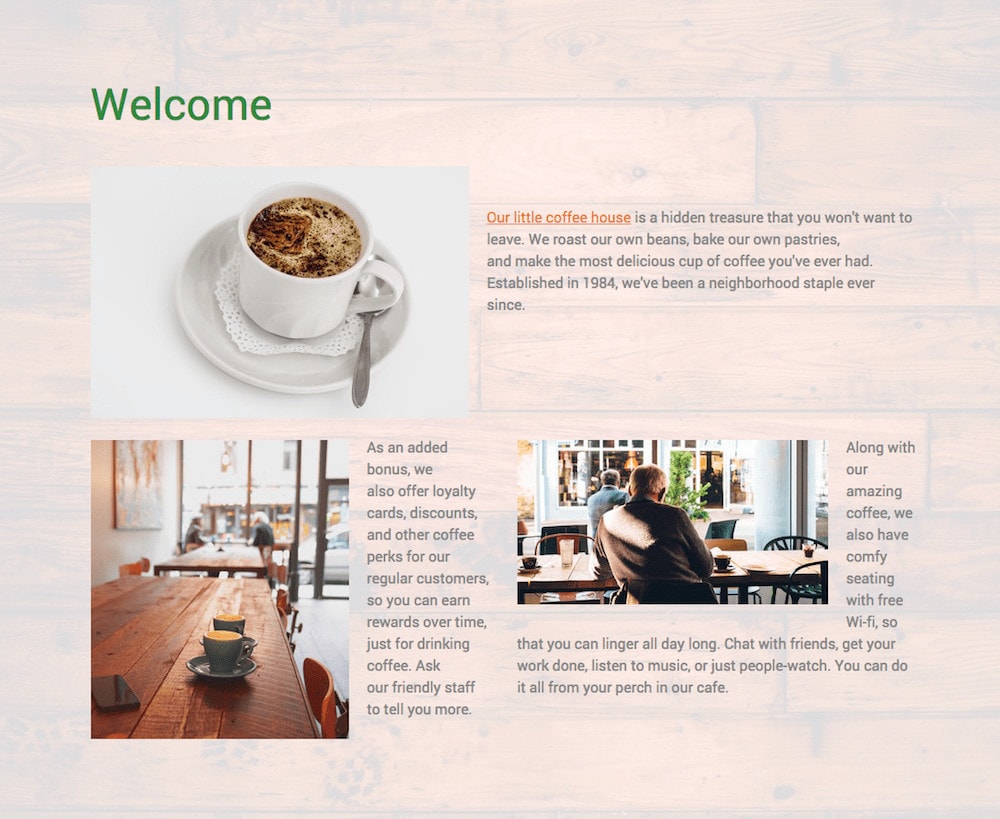
Images on a spider web folio will look better if you lot utilise a consistent style and size. Consistency will also help when lining up your text, columns, and other data on your page. To see what we mean, accept a look at the examples below.
In the kickoff one, taken from our make-believe "Brand-Believe Coffee" website, the photos are all different dimensions. One is oriented vertically, while the others are horizontal. This makes the folio wait disorganized.
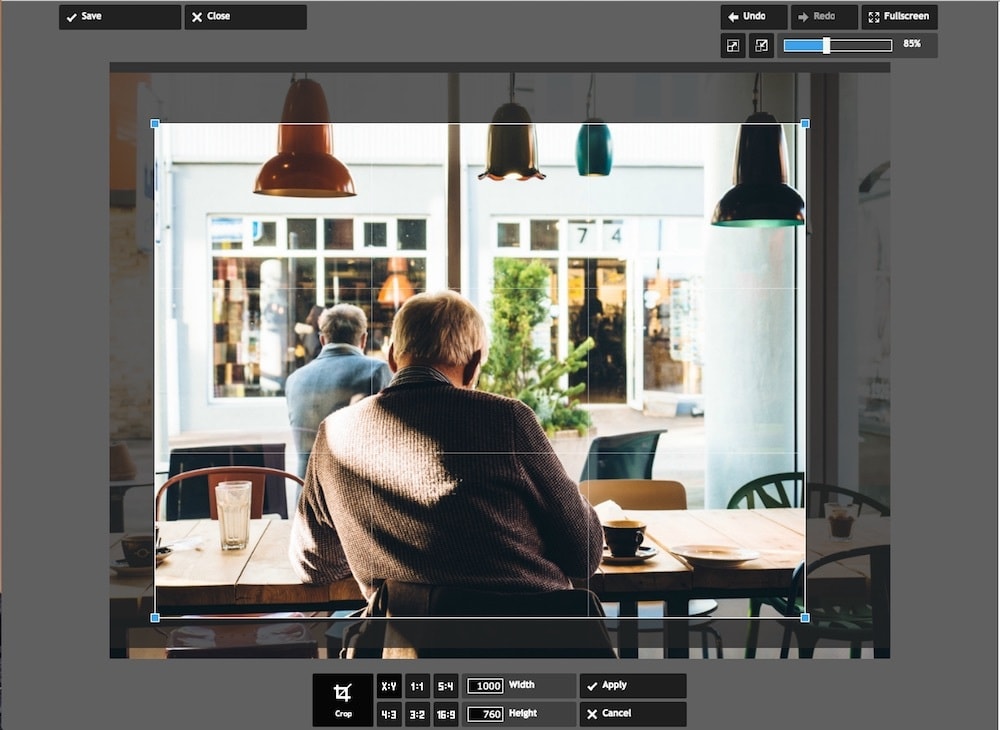
In the next example, I cropped each photo to a more than uniform yard×760 pixels. The top photo of the bright white coffee mug felt out of place, so I replaced it with one that was similar in style and color to my two other photos. I also experimented with the image filters in Jimdo and put in a subtle overlay over each photo (sort of like an Instagram filter) to requite them a more than consequent expect.
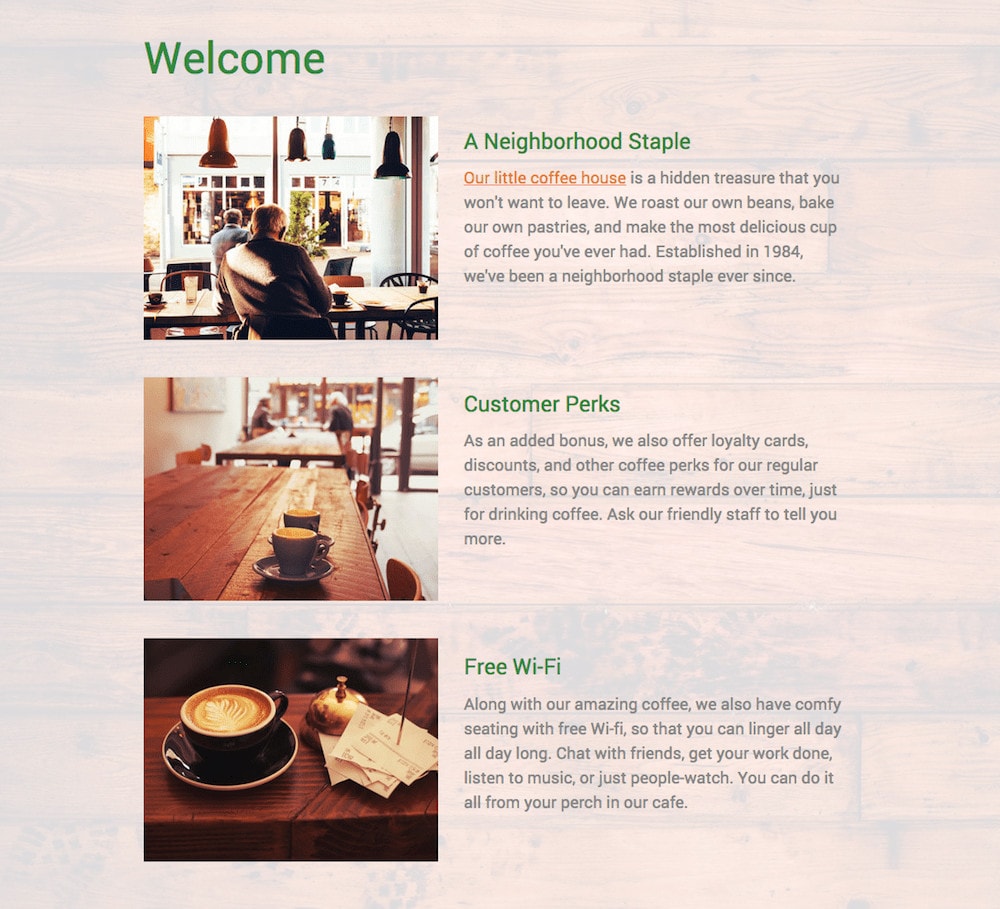
Since the photos are all the same size and oriented the same manner, they all fit perfectly in 1 column, with my paragraphs in another. No adjustments or guesswork needed!
And remember, with a Jimdo website, your images are automatically imported and arranged perfectly, so you lot don't have to worry well-nigh your design.
Ok, at present that your photos are resized and looking great, how tin you optimize them for search engines? On Jimdo websites, much of the SEO housekeeping is taken care of for you lot, but there are however a few tweaks you lot can make to optimize your images.
five. Name the prototype file correctly to help your SEO
Most people don't think much about their file names. They may phone call a photo "Photo1.jpg" or "Screen Shot 2021-06-02 at 3.41.15 PM". If this sounds familiar, accept a moment to rename your images earlier you upload them to your website. Why? Considering doing so makes your photos easier to manage. Depending on where the images appear online, it can as well give your SEO a boost.
For consistency's sake, utilise lowercase letters and numbers 0-ix. Don't introduce punctuation or spaces. And it's all-time to use hyphens rather than underscores. (Think eiffel-tower.jpg rather than DSC12345.jpg).
Note: On Jimdo websites, you don't have to rename all the files on your website—simply update your Alt Text (run into below).
6. Fill up out your captions and alternative text
Once people upload an image to their website, they often forget to fill out the additional information. But just similar the file name, this info gives y'all some added SEO juice.
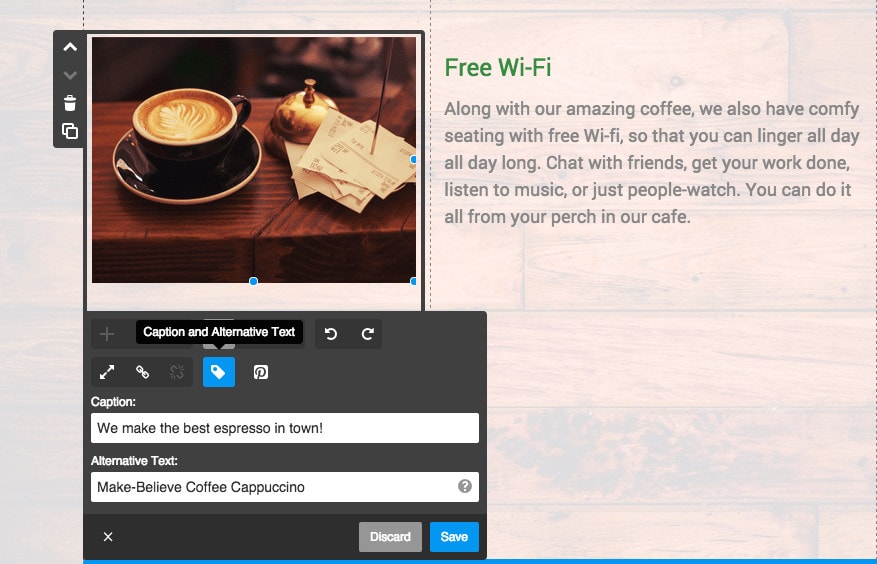
Alt tags (or alternative text) won't be visible to your average company, but they give search engines a basic idea of what each image is nearly. So one time you've added an image to your site, be sure to fill in the Culling Text field with a phrase that describes what the photo is showing, preferably with a targeted keyword. (Alternative text also helps visually dumb visitors navigate your site with sound-based software, so it's a squeamish mode to improve website accessibility.)
If it makes sense, also add together a caption to your paradigm, since people read photo captions more than than other website text.
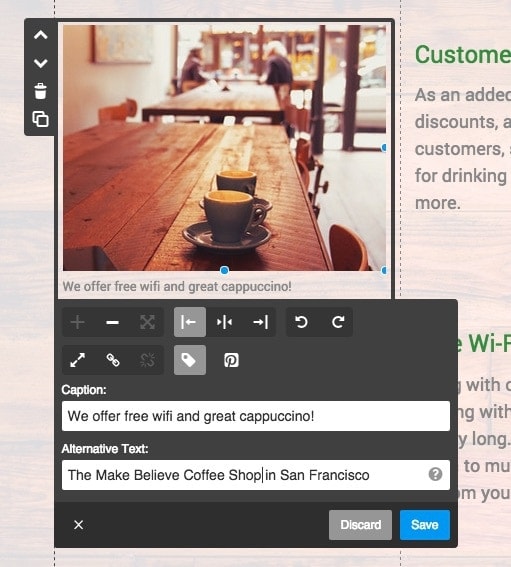
Note: Filling in alt tags, names, and captions is good for SEO, merely don't try to keyword stuff. You just want to accurately draw an epitome in manifestly language—calculation irrelevant or repetitive keywords will get you penalized by the search engine.
7. Put the image near relevant text
Choose images that are related to what the text is saying, rather than something completely out-of-the-bluish. An paradigm that is surrounded by relevant information (with related keywords) will rank better.
This tip likewise helps you avoid stock photo cliches. If your website is about education, you don't get any SEO heave from having a photo of an apple. Photos of teachers, students, and classrooms will exist more interesting for readers and more relevant to your subject area matter.
Summary: Optimizing a website prototype
So let'southward await at these rules with an instance from my Make-Believe Coffee website. I found a photo of a coffee mug on Unsplash. When I downloaded it, the proper noun was "fN6hZMWqRHuFET5YoApH_StBalmainCoffee.jpg" and it was 2509 10 1673 pixels. Its size was 586KB. Non terrible, simply still much larger than I demand for but displaying as a small-scale photograph on my spider web page. So for meliorate image optimization, I would do the following:
- Rename the image to something that makes more than sense. Maybe something similar brand-believe-coffee-cappuccino.jpg
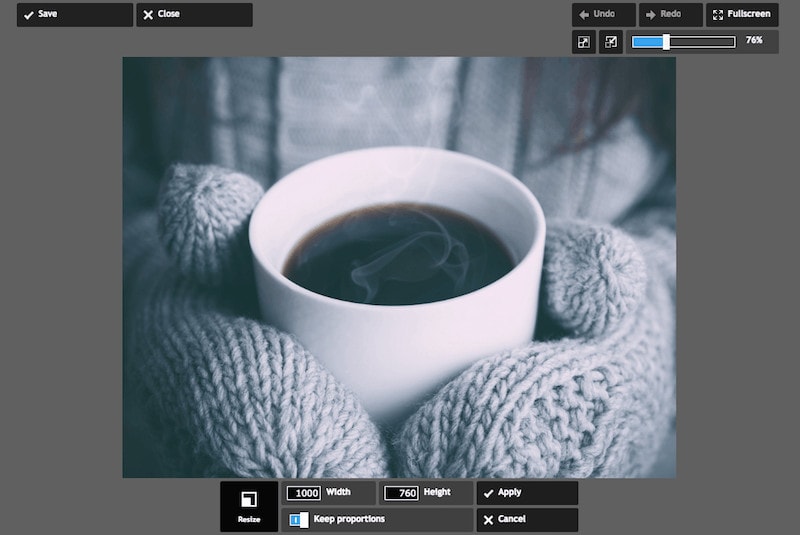
- Use a photo tool to resize and ingather the image to the size I want. For this example I chose 1000×760. If you wanted a square you could do 1000×1000.
- Make certain it'due south the right file size. Once I cropped it to the size I wanted and downloaded it from the photo editor, the file size was 117KB—perfect!
- Upload information technology to your website, and don't forget to fill out the Alt Text! I also added a explanation for good measure.
Even though this checklist might seem like a lot, information technology'll get faster once you're used to the procedure (and you might bookmark this page so y'all can refer back to it).
Plus, going through these step will make your images look better, help your website load faster, and ultimately do good your SEO. Get into the right epitome habits at present, and you'll reap the benefits across your entire website. Ready to go started? Create a concern website or portfolio website with Jimdo today!
Learn how to kickoff your own website today!
Source: https://www.jimdo.com/blog/optimize-website-images-for-better-design-seo/
0 Response to "What Size Should Images Be to Upload to Metromix"
Postar um comentário